Wissenschaftswerkstatt

Wissenschaftswerkstatt in kindergartens
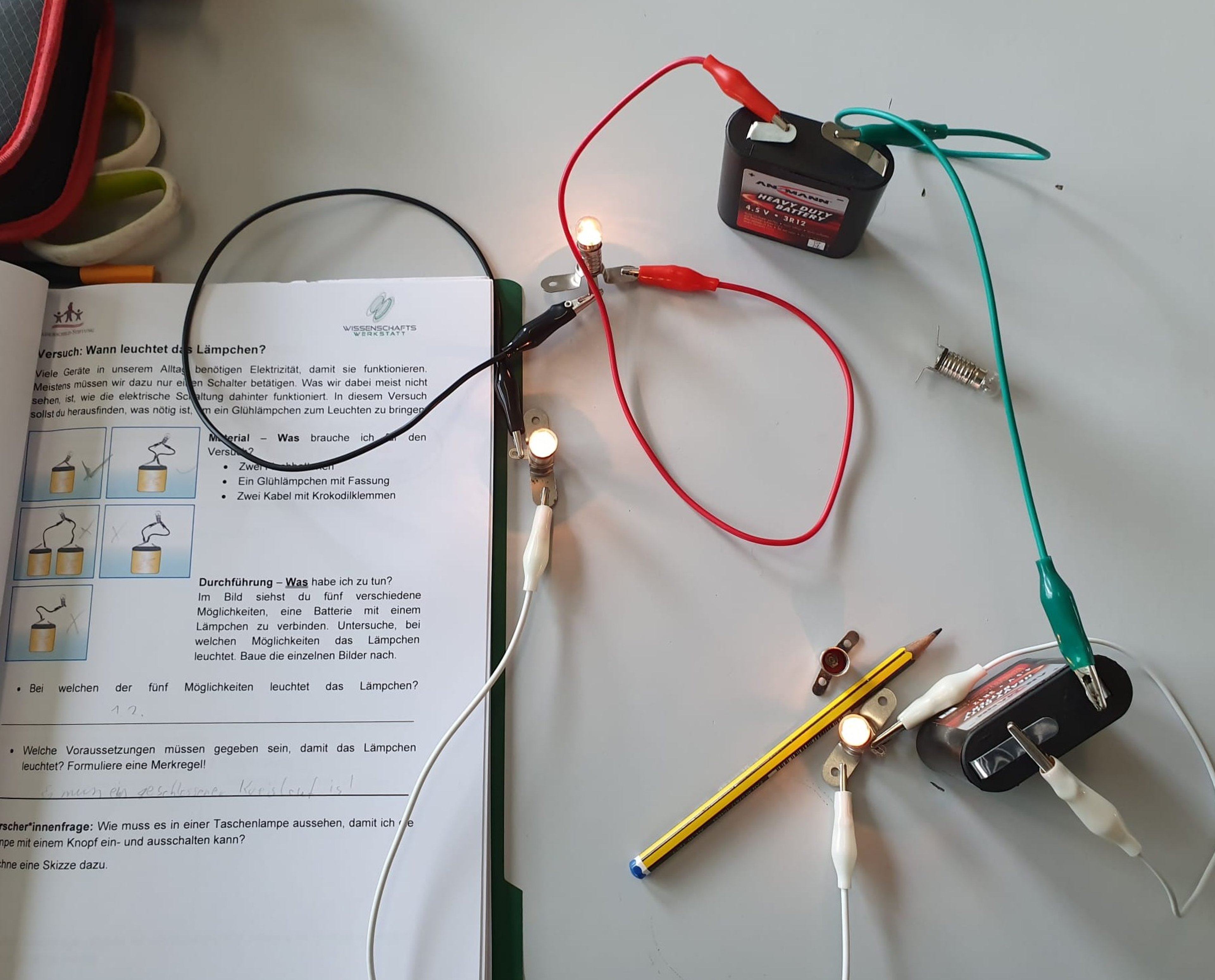
The project Wissenschaftswerkstatt brings science and the joy of experimentation into kindergartens. To make this possible, the Kaiserschild Foundation provides two themed boxes filled with a wide range of materials free of charge for loan. Accompanying resources, including background information and practical suggestions, support educators in implementing the activities.
Themed boxes
Two themed boxes are currently available:
The KliWaWa-Box focuses on climate, forests and water, while the Ba(u)mbini-Box explores the topics of forests, trees and wood.
KLIWAWA-Box
Under the motto “Listen – Experiment – Observe – Understand”, children discover the interconnections between forests, water, soil and climate. Puppet theatre, sensory boxes, hands-on experiments and the KliWaWa song introduce the topic in a playful way. Arts and crafts activities, the creation of different types of landscapes and wooden puzzles further enrich the programme. In addition to scientific knowledge, the activities help develop language comprehension, concentration, memory, social skills and fine motor skills. Accompanying resources, including background information and practical ideas, support educators in implementing the activities.
KLIWAWA - Box
Bau(m)bini-Box
The Ba(u)mbini Box invites children to explore the world of forests, trees and wood through playful discovery. Puppet theatre performances and sensory boxes introduce the different topics, while experiments at interactive research stations encourage children to try things out for themselves and make their own observations. Arts and crafts activities and wooden puzzles further enrich the programme. Elements of Montessori education are also incorporated.Accompanying resources, including background information and practical ideas, support educators in implementing the activities.
Bau(m)bini-Box
How to Borrow
Who can borrow the box?
All kindergartens across Austria can borrow the KliWaWa-Box and the Ba(u)mbini-Box free of charge. The only requirement is to attend an approximately one-hour online introductory session for the respective box. These sessions take place several times a year, with dates announced at the time of booking.
How long can I borrow a box for?
KliWaWa-Box: up to 3 weeks
Ba(u)mbini-Box: up to 5 weeks
If several groups within the same kindergarten would like to use a box, longer loan periods can be arranged upon request. Multiple Ba(u)mbini-Boxes can also be borrowed at the same time.
How does the box get to our kindergarten?
The box is delivered directly to the kindergarten and collected once the loan period has ended.
How can I borrow the box?
Send an email to [email protected].
cooperation partners
Wissenschaftswerkstatt Learning Labs

The Wissenschaftswerkstatt learning labs are based at universities and enable secondary school pupils (Years 7–11) to engage with scientific topics in an extracurricular workshop setting.
Wissenschaftswerkstatt West
At the Kaiserschild Foundation’s Learning Labs at the University of Innsbruck, students from lower and upper secondary schools (Mittelschule and AHS) in Tyrol and Vorarlberg can explore the topics of energy and quantum technology.
In the Energy Transition Learning Lab, students in the 8th grade are challenged to redesign the energy supply of a fictional island nation, moving away from fossil fuels towards a sustainable energy system.
In the Quantum Computing Learning Lab, students in the 11th and 12th grades learn the fundamental concepts of quantum technology and discuss the societal implications of what is known as the second quantum revolution.
Wissenschaftswerkstatt Upper Austria
At the Kaiserschild Foundation’s Learning Lab at the JKU Linz School of Education, students in the 7th grade of lower secondary schools (Mittelschule and AHS) explore mathematics and physics.
The mathematics programme focuses on learning through understanding and hands-on experience. Participants independently develop mathematical knowledge and take home memorable WOW moments and AHA experiences. The physics programme focuses on climate science. Students learn about the greenhouse effect and the albedo effect and investigate how melting ice affects sea levels.
Wissenschaftswerkstatt Styria
In collaboration with the University of Graz, the Kaiserschild Foundation runs two Learning Labs.
The Candela Learning Lab focuses on lighting. Students in the 8th grade of lower secondary schools (MS and AHS) develop a sustainable lighting concept for a fictional school complex. Along the way, they gain knowledge about lighting, sustainable development and health, while strengthening their skills in physics, chemistry and biology.
The Glacier Lab takes place outdoors. On the Dachstein Glacier, upper secondary school students explore the physical, chemical and geographical phenomena of glaciers. The programme aims to raise awareness of the importance and vulnerability of alpine ecosystems and to spark interest in scientific questions.
Cooperation partners
Contact

Mag. Irmgard Mitterbäck
Head of Projects of Education